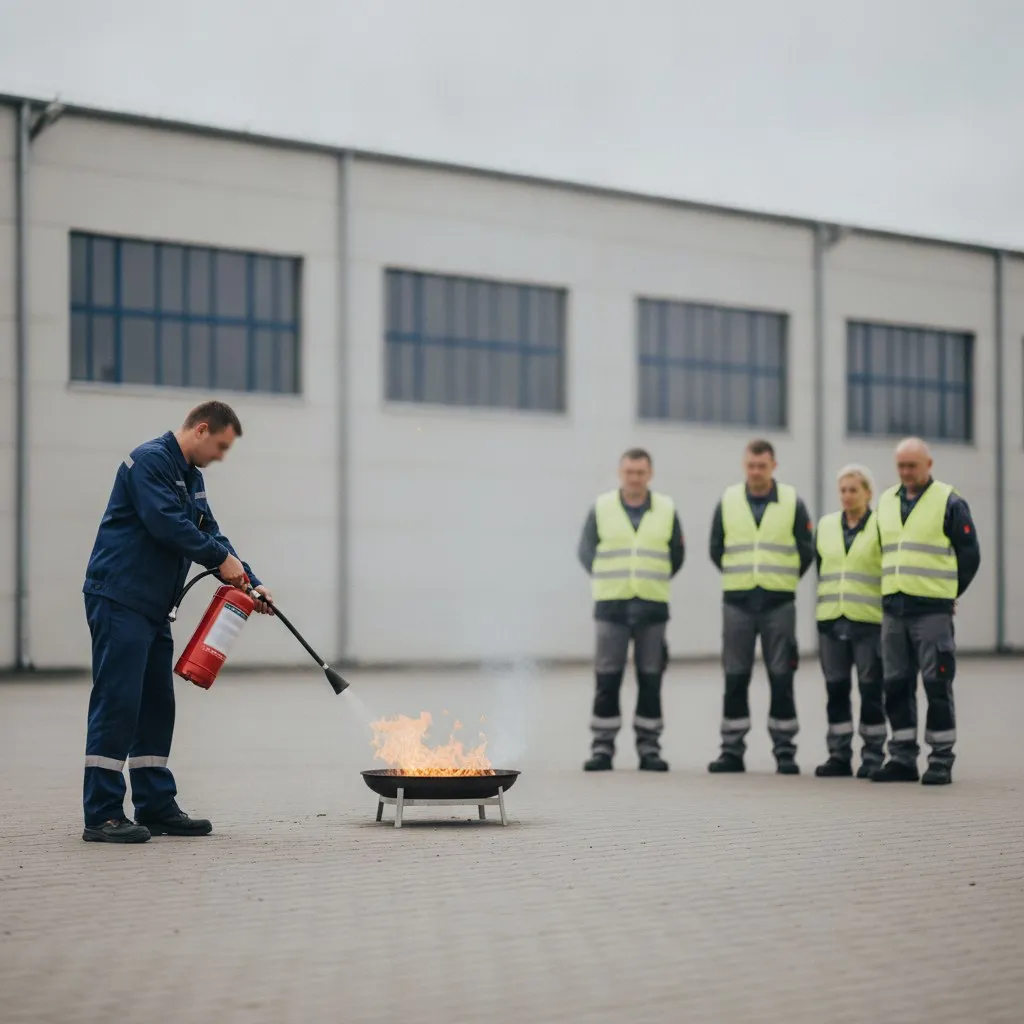
Workplace accident - definition, types and the step-by-step accident procedure
According to preliminary data from Statistics Poland (GUS), 66,733 people were injured in workplace accidents in 2025 - 189 of them died and 486 suffered serious injuries. The accident rate, measured as the number of injured per 1,000 employees, rose for the first time in years - from 4.80 to 4.85. The statistics make one thing clear: an accident at work is not a hypothetical scenario but a real risk, and the first hours after the event decide both the employee’s health and whether the employer correctly fulfils every legal duty. That is why two questions are worth answering in advance: what exactly does the law recognise as a workplace accident, and what must the employer do when one actually happens.
Workplace accident - the statutory definition
The definition of a workplace accident is not found in the Labour Code but in the Act of 30 October 2002 on social insurance for work accidents and occupational diseases (consolidated text, Journal of Laws Dz.U. 2025 poz. 1644). Under its art. 3(1), a workplace accident is a sudden event caused by an external factor, resulting in injury or death, which occurred in connection with work. This yields four conditions that must be met cumulatively: the event must be sudden, caused by an external factor, must result in injury or death, and must occur in connection with work.
The provision also specifies when an event remains “in connection with work”. This covers situations where the employee was injured while performing, or in connection with performing, ordinary duties or the instructions of superiors, while performing tasks for the employer even without an explicit order, and while remaining at the employer’s disposal on the way between the company’s seat and the place where a work-related duty is performed. An accident during a business trip under circumstances other than those listed above is treated equally as a workplace accident, unless it was caused by the employee’s conduct unrelated to the tasks assigned to them.
The definition also matters outside employment contracts. The provisions of the accident act apply, as a rule, also to civil-contract workers (zleceniobiorcy) and persons running a non-agricultural business, because they are covered by mandatory accident insurance - for them, the circumstances of the event are documented in an accident report card (karta wypadku) rather than in an accident protocol.
Types of workplace accidents: fatal, serious and collective
The same art. 3 distinguishes accidents with particularly severe consequences, to which the law assigns a separate regime of duties. A fatal workplace accident is one where death occurred within a period not exceeding 6 months from the day of the accident. A serious accident is an event causing severe bodily harm - for example the loss of sight, hearing, speech or reproductive capacity, an incurable or life-threatening illness, permanent mental illness, total or partial inability to work in one’s profession, as well as permanent, serious disfigurement or deformation of the body. Finally, a collective workplace accident is one in which at least two persons were injured as a result of the same event.
The distinction is no formality: the classification of the event determines whether the employer must immediately notify the labour inspector and the prosecutor, and whether the accident protocol goes to the labour inspectorate for review. It is also worth remembering that not every injury sustained on company premises is automatically a workplace accident. Under art. 21 of the accident act, accident benefits do not apply when the sole cause of the accident was the injured person’s intentional violation of provisions protecting life and health, or gross negligence, or when the injured person, being under the influence of alcohol or intoxicants, contributed to a significant degree to causing the accident. The insured may also lose the right to benefits if they refuse to undergo an alcohol test.
Commute accidents - when they count too
A separate category is the accident on the way to or from work. Art. 57b of the Act on Pensions from the Social Insurance Fund (consolidated text Dz.U. 2024 poz. 1631) defines it as a sudden event caused by an external factor which occurred on the way to or from the place of employment, provided the route was the shortest and was not interrupted. The law does, however, permit a life-justified break within the limits of necessity, as well as the most convenient route in transport terms even if it is not the shortest. The route to the usual place of meals, study, or the usual performance of professional or social functions is also treated as a commute to work.
The procedure differs from the classic one: the circumstances and causes of a commute accident are established in an accident report card for the commute (karta wypadku w drodze do pracy lub z pracy), not in an accident protocol. The card follows the template from a separate regulation and carries similar weight with ZUS - without it, the Fund will refuse to grant benefits. An advantage for the employee is that incapacity for work caused by a commute accident entitles them to sickness benefit at 100% of the assessment basis from the first day (art. 11(2)(3) of the Act on cash benefits from social insurance in case of sickness and maternity, consolidated text Dz.U. 2025 poz. 501).
The accident procedure step by step
The employer’s duties after an accident follow from art. 234 of the Labour Code (consolidated text Dz.U. 2025 poz. 277) and from the Regulation of the Council of Ministers of 1 July 2009 on establishing the circumstances and causes of workplace accidents (Dz.U. 2009 nr 105, poz. 870). Before the team begins its work, the employer ensures first aid is given and eliminates the hazard, and secures the accident site against access by unauthorised persons and against changes to the position of machines and objects that caused the accident (§ 3 of the regulation). Changes at the accident site are permissible only after the inspection and with the employer’s consent, and in fatal, serious and collective accidents after agreement with the labour inspector and the prosecutor; saving people or property is the exception.
The accident team is appointed by the employer. As a standard it includes the OHS service employee and the social labour inspector (§ 4 of the regulation). When the company has no OHS service, its place is taken by the employer, a designated employee, or an external specialist; where social labour inspection is not active, an employee representative with a valid OHS training certificate sits on the team. In small companies where a two-person team is impossible, the circumstances and causes of the accident are established by the employer together with an external specialist (§ 6). The proceedings then follow the same fixed sequence:
- Notify the labour inspector and the prosecutor if the accident is fatal, serious or collective - immediately (art. 234 § 2 of the Labour Code); this also covers other accidents with such consequences.
- Commission the team to establish the circumstances and causes: inspection of the site and equipment, a sketch or photographs where needed, statements of the injured person and witnesses, a medical opinion, the legal classification of the event and preventive conclusions (§ 7).
- Make sure the accident protocol is prepared within 14 days of the day the notification of the accident was received (§ 9), using the template from the regulation of the Minister of Family, Labour and Social Policy of 24 May 2019 (Dz.U. 2019 poz. 1071).
- Familiarise the injured person with the protocol before its approval and inform them of the right to raise objections; a team member may file a dissenting opinion (§ 10-11).
- Approve the protocol within 5 days of its preparation and deliver it to the injured person without delay (§ 13-14); protocols of fatal, serious and collective accidents go to the labour inspector, who may return them if they violate employee rights (§ 15).
- Enter the accident in the accident register (art. 234 § 3 of the Labour Code, § 16 of the regulation) and keep the accident documentation for 10 years (art. 234 § 3¹ of the Labour Code).
- Hand over the complete set of documents to the injured person or to ZUS - without the accident protocol or the accident report card the Fund refuses to grant benefits (art. 22 of the accident act).
The whole procedure also applies to remote work - art. 67²⁷ § 9 of the Labour Code instructs to apply the accident provisions accordingly, and the inspection of the remote accident site is arranged with the employee at an agreed time.
What penalties threaten for accident-related negligence
Failure to notify the labour inspector or the prosecutor of a fatal, serious or collective accident is an offence under art. 283 § 2 pt 6 of the Labour Code, while failure to prepare the accident protocol, keep the accident register or maintain the accident documentation, as well as violations of general OHS provisions and rules by the person responsible for OHS, fall under art. 283 § 1. The fines for these offences were raised by the amendment published in Dz.U. 2026 poz. 473, in force from 8 July 2026.
| Violation | Legal basis | Fine until 7.07.2026 | Fine from 8.07.2026 |
|---|---|---|---|
| Failure to notify the labour inspectorate or the prosecutor of a fatal, serious or collective accident | art. 283 § 2 pt 6 of the Labour Code | PLN 1,000 - 30,000 | PLN 2,000 - 60,000 |
| No accident protocol, accident register or documentation | art. 283 § 1 of the Labour Code | PLN 1,000 - 30,000 | PLN 2,000 - 60,000 |
| Failure to observe OHS provisions and rules by the person responsible for OHS | art. 283 § 1 of the Labour Code | PLN 1,000 - 30,000 | PLN 2,000 - 60,000 |
These sanctions come on top of civil liability - the injured person may pursue damages and compensation from the employer under general rules, independently of ZUS benefits. The rates and labour inspectorate checks are described in detail in our separate article on OHS fines 2026.
Summary
- A workplace accident is a sudden event caused by an external factor, resulting in injury or death, which occurred in connection with work; fatal, serious and collective accidents as well as commute accidents are classified separately.
- After an accident the employer must provide help and secure the site, appoint an accident team, establish the circumstances and causes, prepare the protocol within 14 days, approve it within 5 days and keep the accident register - and in fatal, serious and collective accidents immediately notify the labour inspectorate and the prosecutor.
- Without the accident protocol or accident report card ZUS will refuse benefits, and from 8 July 2026 negligence can cost fines of up to PLN 60,000.
If you want certainty that the accident procedure in your company is complete - from the response instructions to the documentation for ZUS - see our OHS outsourcing services or contact us. We will help you prepare the company for an accident before any of your employees experiences one.
FAQ
How does a workplace accident differ from a commute accident? A workplace accident occurs in connection with performing work or while at the employer’s disposal and is documented with an accident protocol. A commute accident happens on the route between home and the place of employment - provided the route was the shortest (or the most convenient in transport terms) and was not interrupted without justification; it is established in an accident report card for the commute. Both events open the way to benefits from accident insurance.
Who prepares the accident protocol and within what deadline? The protocol is prepared by the accident team appointed by the employer - as a rule consisting of the OHS service employee and the social labour inspector. The deadline is 14 days from the day the notification of the accident was received, and the employer approves the protocol within 5 days of its preparation.
Is an accident at a remote workstation a workplace accident? Yes, if it meets the statutory definition. Art. 234 of the Labour Code and the accident provisions apply accordingly to remote work, and the inspection of the accident site is carried out at a time agreed with the employee; the team may also waive the inspection if the circumstances and causes of the accident raise no doubts.
Will an intoxicated employee receive benefits from ZUS? As a rule, no. Accident benefits are not granted when the sole cause of the accident was the injured person’s intentional violation of life and health protection provisions, or gross negligence, or when an intoxicated employee contributed to a significant degree to causing the accident. Refusal to undergo an alcohol test also results in the loss of the right to benefits.
How much time does the employer have to report an accident to the labour inspectorate? In fatal, serious and collective accidents, notification of the labour inspector and the prosecutor must take place immediately - the provisions set no number of days here, because the immediate response is what counts. The accident protocol, however, has fixed deadlines: 14 days for preparation and 5 days for approval.
What if the employer refuses to prepare the accident protocol? The injured person should report this to the competent district labour inspector - the inspector may conduct an inspection and order the circumstances of the accident to be clarified, and the lack of a protocol deprives the employee of the basis for ZUS benefits, so it is worth reacting immediately. The injured person also has the right to inspect the case files and to raise objections to the team’s findings before the protocol is approved.
Sources
- Act of 30 October 2002 on social insurance for work accidents and occupational diseases - consolidated text (Dz.U. 2025 poz. 1644) - ELI (Polish)
- Labour Code - consolidated text (Dz.U. 2025 poz. 277) - ELI (Polish)
- Regulation of the Council of Ministers of 1 July 2009 on establishing the circumstances and causes of workplace accidents (Dz.U. 2009 nr 105, poz. 870) - ELI (Polish)
- Regulation of the MRiPS of 24 May 2019 on the template of the accident protocol (Dz.U. 2019 poz. 1071) - ELI (Polish)
- Act on pensions from the Social Insurance Fund - consolidated text (Dz.U. 2024 poz. 1631) - ELI (Polish)
- Act on cash benefits from social insurance in case of sickness and maternity - consolidated text (Dz.U. 2025 poz. 501) - ELI (Polish)
- Amendment to the Labour Code and other acts (Dz.U. 2026 poz. 473) - ELI (Polish)
- Statistics Poland - Work accidents in 2025, preliminary data (stat.gov.pl) (Polish)
- National Labour Inspectorate - legal advice: workplace accident (Polish)
Legal status: September 2026. This article is for information only and does not constitute legal advice. For individual cases consult a lawyer or an OHS specialist.