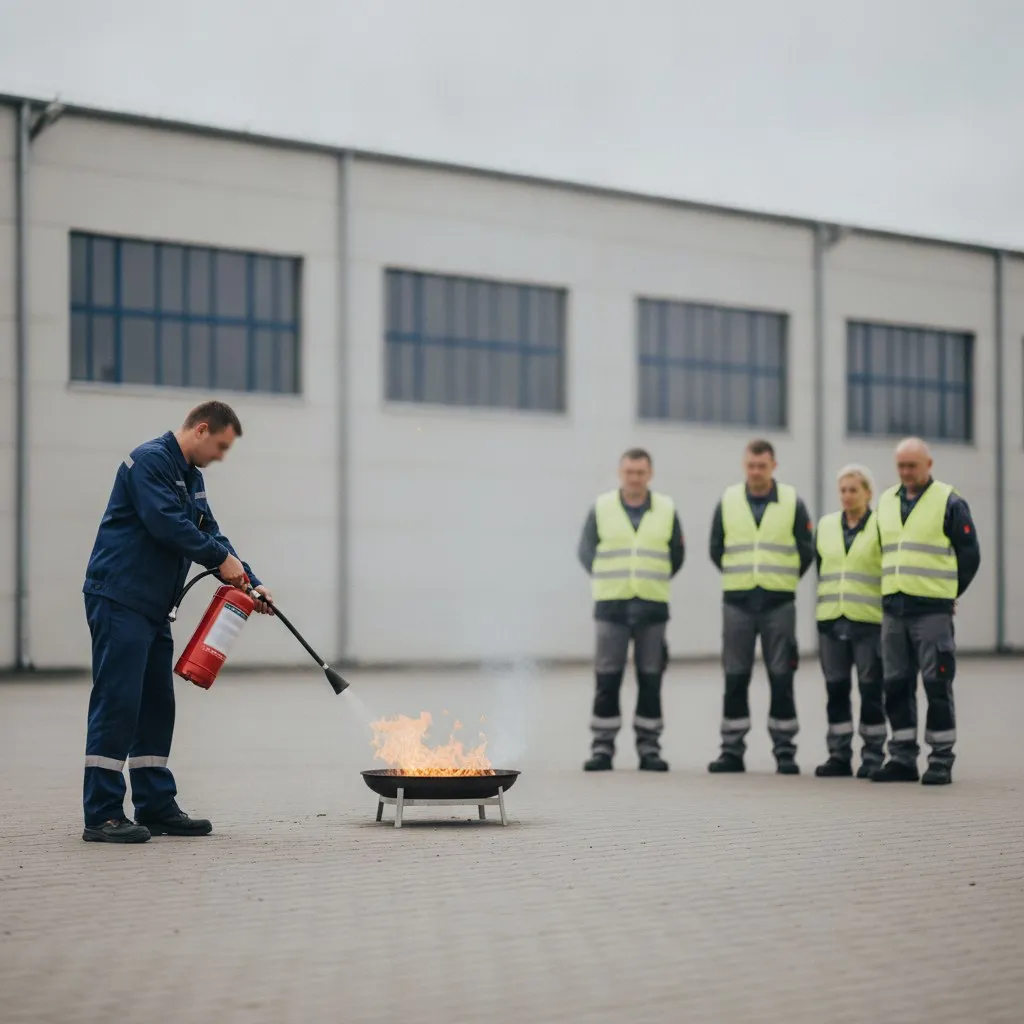
Fire safety training - when is it mandatory, what must it cover and how to document it
A fire extinguisher by the wall, marked emergency exits and vertical escape-route signage - that is the picture most employers have in mind when fire safety comes up. Meanwhile, according to statistics from the Decision Support System of the State Fire Service, Poland recorded 117,139 fires in 2025 alone, and inspections show that the weakest link is rarely the equipment - it is usually people who do not know how to behave in the first minutes of a fire. That raises the question every employer and HR manager eventually faces: is fire safety training really mandatory in our company, in what form, and how should we document it so that an inspection finds nothing to criticize?
Is fire safety training mandatory for employees
Polish law does not provide a separate “fire safety training” statute with its own certificate for ordinary employees. The obligation, however, does exist and has a concrete legal basis: under art. 4(1)(6) of the Act on Fire Protection (consolidated text, Journal of Laws Dz.U. 2025 poz. 188), the owner of a building, structure or site is obliged to familiarise employees with fire protection regulations. The same duty is confirmed by art. 6(1), which requires offices, institutions, organisations, businesses and individuals to acquaint their employees with fire protection regulations. If the building has a manager or user, this responsibility passes accordingly to them under a contract (art. 4(1a)), and in the absence of such a contract it rests with whoever actually controls the facility.
In practice this means two things. First, every employee must be familiarised with fire safety regulations, the content of the fire safety instruction and the procedures to follow in case of fire - and that familiarisation must be documentable. Second, not every company has to organise a separate, “certified” fire safety course: in most workplaces the obligation is fulfilled within OHS training, whose official programmes include dedicated fire safety modules. A separate category applies only to people who professionally perform fire protection activities - they must hold relevant qualifications (art. 4(2)-(2b) of the Act), most commonly the title of fire protection inspector or a fire engineering degree.
Where fire safety fits within OHS training
The simplest route to meeting the obligation runs through the regulation on training in occupational health and safety (consolidated text Dz.U. 2024 poz. 1327). Its model programmes include fire safety content in a fixed, predictable way, so an employer who runs OHS training in line with the regulations automatically covers the fire safety foundations as well.
| Training type | Where fire safety appears | Hours |
|---|---|---|
| General instruction (initial part) | a separate topic: “Basic fire protection rules and behaviour in case of fire” | 1 hour |
| Periodic training of employers and supervisors | topic “Fire protection and environmental protection issues” in the 16-hour programme | 1 hour |
| Periodic training of OHS service | fire and environmental protection topic in the 32-hour programme | 2 hours |
| Periodic training of manual, engineering-technical and office workers | behaviour in case of accidents and emergency situations, including fire and failure | within the hazards topic |
This setup makes business sense: employees do not hear the same material twice, and the employer keeps one coherent training documentation system. Note, however, that on-the-job instruction covers fire hazards only to the extent they follow from the specifics of the workstation - a welding shop or a packaging warehouse requires far more attention here than an administrative desk.
Fire safety instruction - when it is required and what it has to do with training
The regulation of the Minister of the Interior and Administration on fire protection of buildings, other structures and sites (consolidated text Dz.U. 2023 poz. 822) requires providing and implementing a fire safety instruction in buildings used for public services, collective residence, production, warehousing and livestock. The instruction is not required for buildings with no explosion hazard zone and a gross volume of up to 1,000 m³ (livestock buildings up to 1,500 m³), and for sites where the fire zone of a non-building facility does not exceed 1,000 m² (§ 6(8)). A typical office in a townhouse or a small retail showroom stays below the threshold, but any production building, warehouse or larger public-access facility does not.
The instruction is not a shelf document. Its content embeds a training element: § 6(1)(6) requires the instruction to specify how the users of the facility, including employed staff, are to be familiarised with fire safety regulations and with the instruction itself. In a large building, merely having the instruction is therefore not enough - the employer must specify and apply a concrete way of communicating it to employees, most often initial or periodic training combined with a walkthrough of the instruction and a confirmation signature. The instruction is updated at least every 2 years, and after any change in the use of the building or the technological process that affects fire protection conditions (§ 6(7)), so familiarising employees repeats with every update of the document.
Evacuation drills - when they are required
The second practical duty, next to training, is the evacuation drill. Under § 17(1) of the fire protection regulation, the owner or manager of a building intended for more than 50 permanent users, not classified as category ZL IV (low human occupancy), should carry out a practical check of the organisation and conditions of evacuation of the entire building at least once every 2 years. In schools, kindergartens, dormitories and student houses, where groups of more than 50 users change cyclically, the check takes place at least once a year, no later than 3 months after new users start using the building (§ 17(2)).
Two traps deserve attention. The first is the mistaken belief that every company must hold an annual “evacuation rehearsal” - the regulation only requires it in buildings for more than 50 permanent users and allows a two-year cycle. The second is treating the drill as a formality: a fire service inspection will assess not only the fact that it took place, but also the organisation and conditions of the evacuation - the actual passability of escape routes, the working order of signage and how well staff know the procedures.
Penalties for fire safety violations
Liability for violations of fire protection regulations is set out in the Misdemeanour Code. Under art. 82 § 1 (consolidated text Dz.U. 2025 poz. 734), it is an offence to, among others, use open fire or smoke tobacco in prohibited places, perform fire-hazardous work without the required safeguards, violate safety rules for storing fire-hazardous materials, store combustible materials on escape routes, or block access to extinguishers, fire equipment and emergency exits. Following the 2025 amendment to the Misdemeanour Code (Dz.U. 2025 poz. 1814), these acts carry arrest, restriction of liberty or a fine, and in expedited proceedings a fine of up to PLN 5,000 can be imposed.
A separate track concerns training itself: OHS duties, including training programmes with fire safety modules, are supervised by the National Labour Inspectorate, and allowing an employee to work without the required training is an offence punishable by a fine from PLN 2,000 to 60,000 (art. 283 § 1 of the Labour Code). Labour inspectorate and fire service inspections do not exclude each other - the former checks the training system and documentation, the latter the actual state of the building: escape routes, equipment, signage and the preparedness of people.
How to organise fire safety training in your company - step by step
The following sequence of actions closes the topic before an inspection:
- Determine whether your building requires a fire safety instruction - check the building’s use and volume against § 6(1) and (8) of the fire protection regulation; if it does, commission the document from a qualified person (fire protection inspector or fire engineer) and schedule an update every 2 years.
- Include the fire safety module in the initial OHS training of every new employee (a minimum of 1 hour of fire protection rules in general instruction) and keep it in periodic training programmes in line with the model programmes.
- Add a walkthrough of the fire safety instruction to the training: alarm procedures, escape routes, the location of extinguishers and the employees’ fire protection duties.
- Document the familiarisation: an attendance list or signatures on training cards with a note about the fire safety scope is the simplest proof that the duty under art. 4(1)(6) has been fulfilled.
- Check the evacuation drill obligation: a building for more than 50 permanent users means a practical evacuation check at least once every 2 years, and in schools with rotating groups - once a year.
- Before an inspection, walk through the building: extinguishers with valid service tags, unobstructed escape routes and exits, unblocked fire equipment, an up-to-date instruction available to rescue teams.
Frequently asked questions
Is fire safety training mandatory for all employees? Yes, in the sense that every employee must be familiarised with fire safety regulations (art. 4(1)(6) of the Fire Protection Act). In practice this is done through the fire safety module of OHS training and a walkthrough of the fire safety instruction. Separate qualifications are required only from people who professionally perform fire protection activities.
How often is fire safety training repeated? The regulations do not set a separate cycle for “fire safety training”. Fire safety content recurs within OHS training cycles: initial training before starting work, and periodic training every 1-6 years depending on the job group. The fire safety instruction is updated at least every 2 years, and on each of these occasions employees should be re-familiarised with the changes.
Can fire safety training be delivered as e-learning? For employee OHS training the form is set by the OHS training regulation and must be followed (guided self-study with consultations is allowed only for non-manual groups in periodic training). If, however, the employer delivers the familiarisation with fire regulations outside the OHS training structure, fire regulations do not prescribe a form - they require it to be effective and documented, and in buildings with a fire safety instruction, the way of familiarising staff must follow from the instruction itself.
Who can conduct fire safety training in a company? The fire safety module of OHS training is delivered by a person meeting the trainer requirements of the OHS training regulation. When a company outsources fire protection activities - such as developing the fire safety instruction - the contractor must hold the qualifications of art. 4(2)-(2b) of the Fire Protection Act, most commonly fire protection inspector credentials.
Does a small office also need a fire safety instruction? Not always. The instruction is not required for buildings without an explosion hazard zone with a volume of up to 1,000 m³. The duty to familiarise employees with fire safety regulations applies regardless of company size, and documenting it within OHS training is the simplest way to fulfil it.
What happens if an emergency exit is blocked or extinguishers are hidden away? That is an offence under art. 82 § 1 of the Misdemeanour Code: the provision explicitly lists blocking access to extinguishers, fire equipment and emergency exits, and storing combustible materials on escape routes. It carries arrest, restriction of liberty or a fine - up to PLN 5,000 in expedited proceedings.
Summary
- The duty to familiarise employees with fire safety regulations follows directly from the Fire Protection Act, and the most convenient way to fulfil it is through the fire modules of OHS training - initial (1 hour in general instruction) and periodic.
- A production, warehouse or public-access building needs a fire safety instruction, updated at least every 2 years; it is the instruction that must describe how employees are familiarised with fire regulations.
- An evacuation drill takes place at least every 2 years in buildings for more than 50 permanent users (annually in schools and kindergartens), and fire safety violations can cost up to PLN 5,000 in expedited proceedings or a court sentence.
If you are unsure whether fire safety in your company is complete - from the fire safety instruction, through OHS training modules, to evacuation drills - see our fire protection training offer or contact us. We will help you close the gaps before they surface during an inspection.
Sources
- Act of 24 August 1991 on Fire Protection - consolidated text (Dz.U. 2025 poz. 188) - ELI (Polish)
- Regulation of the MSWiA on fire protection of buildings and sites - consolidated text (Dz.U. 2023 poz. 822) - ELI (Polish)
- Regulation of the MRiT on training in occupational health and safety - consolidated text (Dz.U. 2024 poz. 1327) - ELI (Polish)
- Misdemeanour Code - consolidated text (Dz.U. 2025 poz. 734) - ELI (Polish)
- Amendment to the Misdemeanour Code and the Misdemeanour Proceedings Code (Dz.U. 2025 poz. 1814) - ELI (Polish)
- State Fire Service incident statistics 2025 (SWD PSP) - dane.gov.pl (Polish)
- National Labour Inspectorate - legal advice: OHS training (Polish)
Legal status: September 2026. This article is for information only and does not constitute legal advice. For individual cases consult a lawyer or an OHS and fire safety specialist.