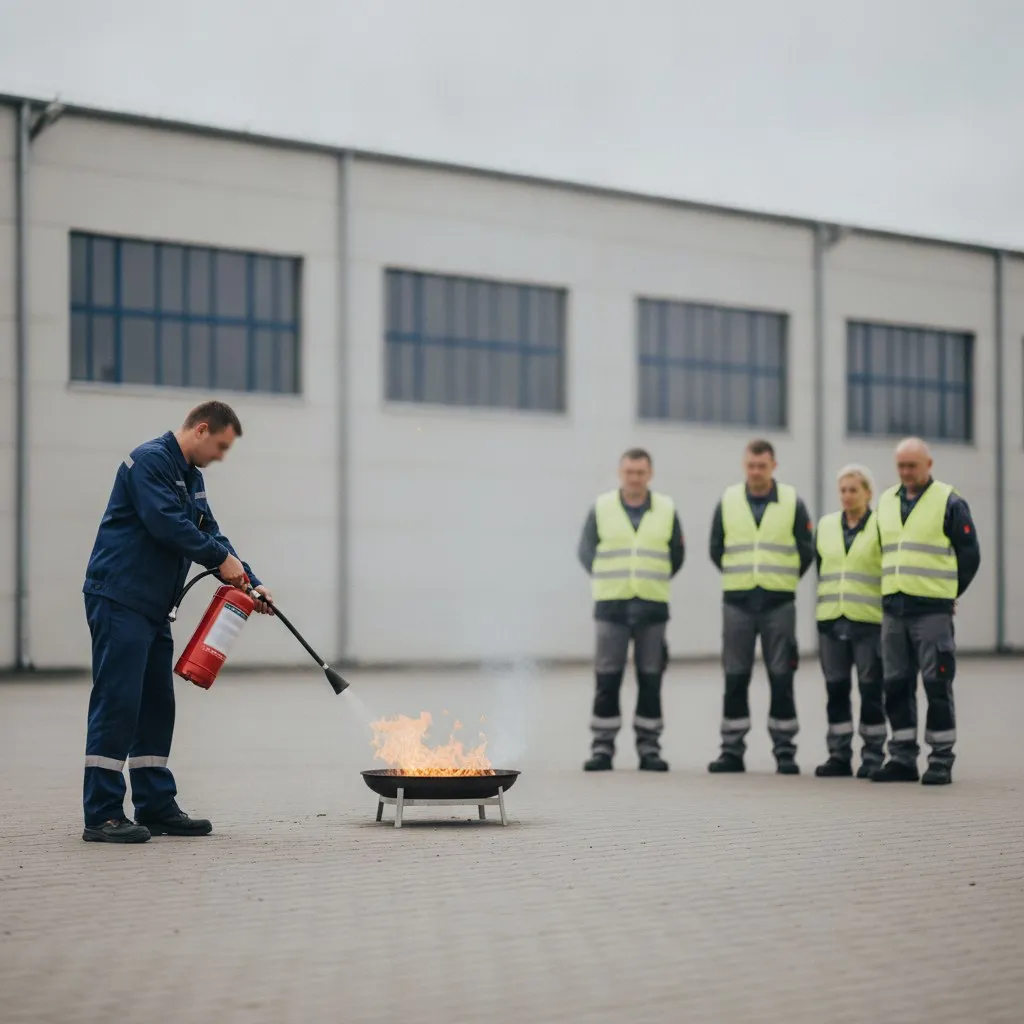
Health and Safety in Construction - Essential Site Safety Rules
In 2021, 120 workers died on Polish construction sites; three years later - 67. Construction remains the sector with the highest risk of fatal accidents, and during PIP inspections the most common direct hazard is work at height without fall protection. If you manage a construction site, you are personally responsible - and as of 8 July 2026, fines for OHS violations reach PLN 60,000.
Why construction is the highest-risk industry
Construction consistently ranks at the top of accident statistics - work at height, heavy machinery traffic, variable weather and schedule pressure form a combination where a small oversight ends in tragedy. The Labour Code and detailed regulations impose specific duties on the site manager, and failing to meet them now carries a penalty under Art. 283 § 1 of the Labour Code.
Duties on the construction site - who is responsible for what
Several people are responsible for safety on a construction site at once, and the boundaries of that responsibility are set by law. The site manager supervises compliance with OHS regulations, prepares the BIOZ plan, coordinates work carried out simultaneously that may create mutual hazards, and formally accepts safety measures - from scaffolding to excavation edges - with protocols.
The employer must train workers and refer them for medical examinations, carry out the occupational risk assessment, and provide personal protective equipment - free of charge and matched to the specific hazards. The worker, in turn, must follow OHS rules, use the assigned PPE properly, and report any irregularities to superiors.
It is worth remembering that liability for violations falls on the individual, not the company - the site manager and the employer are personally responsible, and as of 8 July 2026 the penalty rates have doubled (on-the-spot fines up to PLN 10,000 for a repeat violation).
Required training and qualifications
Before a worker even enters the construction site, they must complete introductory OHS training, consisting of general instruction and on-the-job instruction at the workplace. Then the cycle repeats: periodic training for manual positions takes place every 3 years, and for particularly hazardous work even more often. In addition to training, some positions require separate qualifications - machine operation supervised by UDT, electrical work with SEP authorisations, welding or work at height. Medical examinations come on top: initial before employment, then periodic, and on some positions additionally specialist preventive examinations.
Lapsed training is one of the most common violations found by PIP inspectors on construction sites - and the easiest to avoid.
The most common hazards and how to avoid them
| Hazard | Basic protections |
|---|---|
| Fall from height | Safety harness, edge protection, compliant scaffolding, equipment checks |
| Electrical hazards | Installation inspections, certified equipment, cable protection |
| Earthworks | Excavation shoring, hazard zone marking, proper material storage |
| Falling objects | Buffer zones, edge guards, tool tethering |
During PIP inspections the most common direct hazards on construction sites are work at height without fall protection and without required personal protective equipment; falls from height dominate among the events causing the most severe accidents. Each of these scenarios has a proven protection playbook - and almost every such accident traces back to neglecting rules that already exist.
OHS documentation on the construction site
The core of the documentation is the BIOZ plan - required by regulation for sites where work is expected to last more than 30 working days with at least 20 workers, exceeds 500 person-days, or involves particularly hazardous work. The plan sets out how safety has been organised on the specific site: anticipated hazards, the sequence of works and protective measures.
Alongside it, the employer maintains position-level documentation: the occupational risk assessment for every position - with particular hazardous work assessed separately - and workplace instructions wherever hazardous factors are present. During an inspection, the PIP inspector will also ask for the training and medical examination registers of everyone working on the site, as well as acceptance protocols for safety measures, scaffolding and equipment.
Key takeaways
- Most severe construction accidents are falls from height - and their causes are identified and predictable.
- The site manager is personally liable (fine up to PLN 60,000, on-the-spot fine up to PLN 10,000) - documentation and supervision are his shield.
- Current training + complete documentation (BIOZ, risk assessment, instructions) is the minimum PIP checks first.
How to prepare your site for a PIP inspection
- Verify introductory and periodic training for all workers - including e-learning for office staff.
- Update the occupational risk assessment and BIOZ plan for the current construction stage.
- Check acceptance protocols for scaffolding and edge protection.
- Review position instructions covering particularly hazardous work.
- Set up an accident reporting procedure and brief the works managers.
Need training updates or documentation support? Lenax offers OHS training and comprehensive OHS outsourcing - check our services or contact us.
FAQ - the most common questions about construction site OHS
What OHS training is required for construction work? Introductory OHS training (general instruction + on-the-job instruction) before being allowed to work, periodic training every 3 years for manual positions, and specialist qualifications (UDT, SEP) for the equipment operated.
Who is responsible for OHS on a construction site? The site manager supervises compliance with regulations; the employer handles training, medical examinations and equipment. Violations under Art. 283 of the Labour Code are committed by an individual - the penalty applies to a specific person, not the company.
Is a BIOZ plan mandatory on every construction site? The BIOZ plan is required when: (1) construction work is expected to last more than 30 working days with at least 20 workers employed simultaneously, or the total workload exceeds 500 person-days, or (2) particularly hazardous work is carried out (including burial risk, falls from height, underground work, work near high-voltage lines). For other sites, the site manager prepares a health and safety information document.
Sources
- Labour Code - consolidated text (ELI)
- Regulation of the Minister of Infrastructure on occupational health and safety during construction works - consolidated text (Dz.U. 2003 no. 47 item 401) - ELI
- Regulation of the Minister of Infrastructure on health and safety information and the health and safety plan (BIOZ) (Dz.U. 2003 no. 120 item 1126) - ISAP
- PIP - “Fewer accidents are a shared success” (14 May 2026): construction is the sector with the highest fatal-accident risk; 120 deaths in 2021, 67 in 2024
- Act of 11 March 2026 amending the Act on the National Labour Inspection and certain other acts (Dz.U. 2026 poz. 473) - ELI
- Regulation on health and safety training (Dz.U. 2024 item 1327) - ELI
- PIP - Report on the activities of the State Labour Inspection in 2025 (Sejm document no. 2773)
Legal status: September 2026. This article is for information only and does not constitute legal advice. For individual cases, consult a lawyer or an OHS specialist.